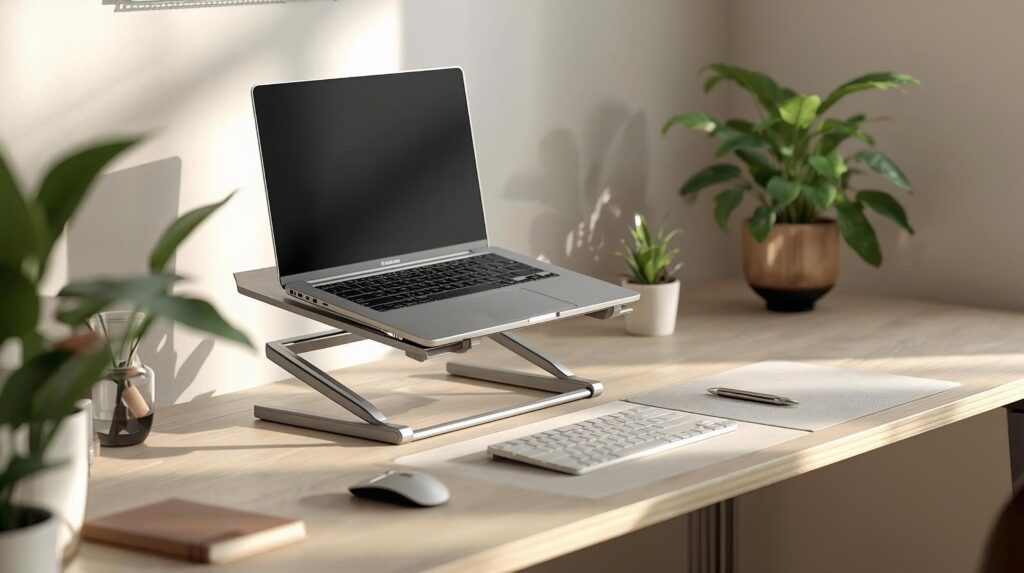
If you work on a laptop for hours a day, you’ve likely felt the classic combo: neck strain, rounded shoulders, and a tight upper back. The main reason is simple laptop screens sit too low, forcing you to look down for long periods.
A laptop stand for home office use is one of the fastest ergonomic upgrades you can make. It helps raise your screen closer to eye level, improves airflow, and frees desk space. For best results, pair it with an external keyboard and mouse when you lift the laptop high.
If you want to go beyond just a laptop stand and fix your full workstation comfort, follow our step-by-step guide on how to adjust your desk setup for better ergonomics ↗. It helps you align chair height, screen distance, keyboard position, and lighting for long work sessions.
In this guide, you’ll find five of the best laptop stands for home office setups, plus a practical checklist to choose the right one for your desk, travel needs, and posture goals.
Disclosure: This post may contain affiliate links. If you buy through them, we may earn a commission at no extra cost to you.
Quick comparison: best laptop stands for home office
| Laptop stand | Best for | Type | Adjustability | Portability | Buy |
|---|---|---|---|---|---|
| Rain Design mStand | Clean, sturdy everyday setup | Fixed aluminum stand | No | Medium | Check price |
| Amazon Basics Adjustable Stand | Value + simple ergonomic lift | Foldable adjustable stand | Yes | Medium | See on Amazon |
| MOFT Invisible Laptop Stand | Ultra-portable + always-on use | Adhesive ultra-thin stand | Limited (2 heights) | Very high | View on Amazon |
| Soundance LS1 | Simple cooling + value | Fixed ventilated stand | No | Low–Medium | Check availability |
| BoYata Adjustable Stand | Stable ergonomic flexibility | Adjustable desk stand | Yes | Medium | Shop now |
| tounee Adjustable Laptop Stand | Sit-stand ergonomic flexibility | Telescopic adjustable stand | Yes | Low | See details |
Why you need a laptop stand
A quality ergonomic laptop stand can improve comfort and workflow in a few important ways:
- Better screen height: Reduces the need to bend your neck down for long periods. OSHA notes the top of the monitor should be at or slightly below eye level, with the screen center typically about 15–20° below horizontal eye level.
- More neutral viewing distance: Mayo Clinic suggests placing your screen about arm’s length away, generally 20–40 inches, depending on your vision and setup.
- Improved airflow: Elevation can help laptops dissipate heat better, especially with open/ventilated designs.
- More desk space: Many stands create usable space under the laptop for a keyboard, notebook, or dock.
- Cleaner “real workstation” feel: Small upgrade, big difference in how your desk functions. If you’re working with a compact desk, our Small-Space Setup Guide can help you make better use of limited depth and surface area.
Important ergonomic note: If you raise your laptop high, you’ll usually want an external keyboard and mouse so your arms stay comfortable while your screen stays high.
Types of laptop stands
Adjustable laptop stands
Best for: shared desks, posture fine-tuning, multi-tasking
You can change height/angle to match your chair, desk height, and body.
Fixed-height stands
Best for: stable home office setups
Simple, sturdy, and often the cleanest-looking option if the height works for you.
Portable folding stands
Best for: coffee shops, travel, hybrid work
Lightweight and packable, often with multiple height levels.
Adhesive ultra-thin stands
Best for: minimalists and frequent travelers
They stay attached to your laptop, so there is no extra gear to pack, but they offer limited lift.
Vertical stands (not covered in the 5 picks below)
Best for: external monitor + “clamshell mode” (laptop closed)
Saves desk space and keeps your setup tidy.
Best laptop stands for home office: top picks
1) Rain Design mStand — Best overall fixed stand
If you want a simple, sturdy, premium-feeling stand that looks great on a desk, the mStand is a classic fixed-height option.
Key highlights
- Raises screen height by about 5.9 in / 15.0 cm
- Single-piece aluminum design
- 2-inch rear cable-management hole
- Compatible with laptops with depths under 10.4 inches
Pros
- Very simple fixed design
- Extremely stable for everyday use
- Clean “set it and forget it” setup
- Great for a dedicated home office desk
- Aluminum body is described as acting as a heat sink
Cons
- Not adjustable
- Amazon.com ties compatibility to laptop depth, so it is less universal than open-fit adjustable stands
- Best fit is for a more permanent desk setup, not for frequent packing and travel
Best for: A tidy home office desk where you want stability and a premium look.
2) Amazon Basics Adjustable Laptop Stand — Best value adjustable stand
This is the easiest value pick if you want real height adjustment without moving into a heavier sit-stand design.
Key highlights
- 8 height positions
- Raises screen height by about 7.0 in / 17.8 cm
- Lightweight (listed around 1.7 lb. / 0.77 kg)
- Fits laptops from 10.0 to 17.3 in / 25.4 to 43.9 cm
- Max load capacity listed at 11 lb. / 5.0 kg
Pros
- Clear height adjustment range
- Broad laptop-size compatibility
- Folds flat for storage or travel
- Ventilated design and silicone pads are useful practical touches
Cons
- It is more of a desk-and-bag hybrid than a full sit-stand option
- The listing focuses on height adjustment, not angle adjustment
Best for: Anyone who wants an adjustable stand with good value and simpler specs than a large telescopic model.
3) MOFT Invisible Stand — Best ultra-portable “always with you” option
This is for people who want maximum portability and zero extra packing. It sticks to the bottom of your laptop.
Key highlights
- Adhesive slim design
- About 0.1 in / 0.3 cm thick
- Light weight about 3.07 oz / 87 g
- Compatible with laptops up to 15.6 in / 39.6 cm
- Supports up to 11 lb. / ≈ 5 kg
- For laptops without underside air vents
- Uses two angles 25° and 15°
Pros
- Extremely thin and light
- Always attached = incredibly convenient
- Great for quick posture improvement on-the-go
- Minimal aesthetic
Cons
- Limited lift compared to full-height stands
- Works best on stable, flat surfaces
Best for: Minimalists, frequent travelers, and laptop-only sessions where you want a quick improvement without carrying gear.
4) Soundance LS1 — Best simple cooling + value
The LS1 is the simple fixed metal stand in this lineup. It is easy to understand and fits the “set it on the desk and leave it there” use case.
Key highlights
- Fixed aluminum riser
- Wight 2.2 lb. / ≈ 1.0 kg
- Compatible with laptops from 10″ to 15.6″
- Supports up to 8.8 lb. / ≈ 4 kg
- Open design that supports airflow under the laptop
Pros
- Good value for a simple desk upgrade
- Open design supports airflow
- Easy to set up, nothing to “tune”
Cons
- Not adjustable
- Narrower compatibility range
Best for: Home office users who want a simple stand that improves airflow and desk organization without paying for adjustability.
5) BoYata Adjustable Laptop Stand — Best for stability + ergonomic flexibility
This is the desk-stable adjustable option in the middle of the lineup. It is more substantial than the travel-first models but not as tall as the sit-stand tounee.
Key highlights
- Wight 2.46 lb. / 1.12 kg
- Compatible with laptops between 10.0 to 17.0 in
- Can be inclined at different angles and can be set higher or lower depending on your needs
- Vent hole on the surface
- Anti-slip support: 4 slide-proof silicone pads on the bottom
Pros
- Adjustable for both angle and height position
- Vent hole and metal construction support airflow
- Silicone pads help with grip and desk stability
- Broader size compatibility than the fixed LS1 and MOFT
Cons
- Bulkier than travel-first stands
- Better suited to a desk than to constant carrying in a bag
- Adjusting hinges may require occasional tightening (depending on design)
Best for: Users who want adjustability and a stable desk setup without going full travel-light.
6) tounee Telescopic Laptop Stand — Best sit-stand adjustable option
If you want the biggest adjustment range in this group, this is the one that stands out.
Key highlights
- Wight 3.92 lb / 1.78 kg
- Raises screen height between 2.1 to 21.0 in / 5.3 to 53.3 cm
- Fits laptops from 10 to 17 in
- Max load capacity listed at 22 lb. / 10.0 kg
- Base: 360° swivel
Pros
- Biggest height range in this lineup
- Built for both sitting and standing use
- 360° swivel base is useful if you turn the laptop toward someone else on the desk
- Higher listed load support than the Amazon Basics and MOFT stands
Cons
- Heaviest stand in this lineup
- More desk hardware than travel accessory
- Takes you into a different use case from simple fold-flat risers, so it may be more than some users need
Best for: People who want real sit-stand adjustment and a much taller working range than a normal desk stand.
How to choose the right laptop stand (simple checklist)
1) Decide how you actually work
- Laptop open all day: prioritize height/angle adjustability
- Laptop + external monitor (clamshell mode): consider a vertical stand instead
- Hybrid (home + cafes): prioritize portability + fast setup
2) Match the stand to your mobility
- Home-only: fixed or sturdy adjustable desk stands
- Travel often: folding stand or adhesive ultra-thin stand
- Both: portable adjustable stand is the best compromise
3) Confirm laptop fit
Check:
- Screen size compatibility range
- Weight capacity (especially for larger laptops)
- Whether the stand blocks ports you use
4) Choose the right adjustability level
- Fixed height: simplest and often most stable
- Height + angle adjustable: best for dialing in posture and glare control
5) Pick materials that match your priorities
- Aluminum: premium feel + good heat dissipation
- Reinforced nylon/plastic: lighter, often more portable
- Wood: aesthetic-focused (often pricier)
Ergonomic setup guidelines (use this with any laptop stand)
Screen height & viewing angle
- Keep the top of the screen at or slightly below eye level.
- Typical guidance places main viewing area about 15–20° below horizontal eye level.
Screen distance
- Start around arm’s length; Mayo Clinic suggests roughly 20–40 inches, adjusting for comfort and readability.
The “complete” laptop-stand setup
For best posture:
- Laptop stand (screen up)
- External keyboard + mouse (arms comfortable)
- Chair with lumbar support
- Lighting to reduce glare
If you also use a separate display, read Best Monitor Setup for Productivity ↗ for a cleaner and more comfortable screen layout.
Setup tips (so your stand actually helps)
- Start with a moderate height, then adjust over a few days
- Keep the screen centered in front of you
- If the laptop is high, use an external keyboard/mouse
- Route cables cleanly so they don’t pull the laptop or clutter your workspace
To keep the stand stable and the desk tidy, use cable management essentials for a clean desk setup ↗.
Common mistakes to avoid
- Raising the laptop high but still typing on the laptop keyboard (screen gets better, arms/shoulders get worse)
- Setting the screen too high and looking upward
- Using a portable stand on a soft/uneven surface
- Ignoring load limits for heavier laptops
Using an external monitor too? Check best monitor arms for home office ↗ for easier height and distance adjustment.
FAQs
Is a laptop stand worth it for a home office?
Yes, if you spend hours on a laptop, raising the screen helps reduce neck bending. OSHA’s monitor guidance supports keeping the top of the screen at or slightly below eye level.
Do I need an external keyboard and mouse?
If you raise your laptop significantly, an external keyboard and mouse usually help keep your arms in a comfortable position while the screen stays high.
What’s better: fixed or adjustable?
Fixed stands are simpler and stable. Adjustable stands are better if you share a desk, change chairs, or want precise ergonomic tuning.
How far should my screen be from my eyes?
A common starting point is arm’s length. Mayo Clinic suggests roughly 20–40 inches, depending on comfort and visibility.
Final thoughts
The best laptop stands for home office use do two things well: raise your screen and support the way you work (home-only, hybrid, or travel-heavy). If you want a clean fixed setup, go with a sturdy aluminum stand. If you need flexibility, an adjustable stand makes posture tuning much easier.
Next step: pick one stand style that fits your routine and if you lift the laptop high, add a keyboard and mouse so the upgrade truly improves comfort.
For smaller desks, tighter layouts, or multi-use rooms, the Small-Space Setup Guide ↗
is the best next step.
Sources & references
- OSHA –Computer Workstations (Monitor positioning) ↗
- Mayo Clinic –Office ergonomics guide ↗
- OSHA – Working positions & movement breaks ↗
- Cornell University – Ergonomics resources ↗